Skip to content

Snowbirds and US Taxes: Why ‘Just Visiting’ Can Still Mean a Filing Obligation

5 min read

Every fall, hundreds of thousands of Canadians head south to trade slush for sunshine. And every spring, a few of them discover — usually at the border, or in a letter from the IRS — that their winters in Florida or Arizona came with a tax filing obligation they never knew existed. Here is the part that surprises almost everyone: you can owe the IRS a filing without earning a single dollar of US income. The filing itself, not the tax, is what keeps you protected.

The Substantial Presence Test: it's not '183 days per year'

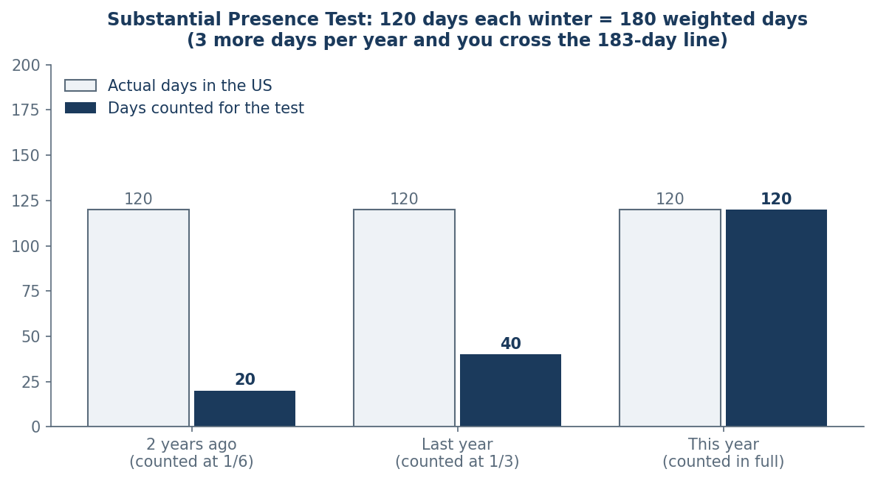
Most snowbirds believe they are safe as long as they stay under six months in a calendar year. The IRS test doesn’t work that way. Under the Substantial Presence Test, you are treated as a US tax resident if you spend 31 or more days in the US this year and your weighted three-year total reaches 183 days, counting:

  • All days in the US this year,
  • One-third of your days last year, and
  • One-sixth of your days two years ago.

Partial days generally count as full days. Run the math on a typical snowbird pattern and you’ll see how tight it is:

A consistent 120-day winter produces 180 weighted days — just three days per year below the 183-day threshold. Roughly four months every winter is the practical danger zone.

Over the line? The Closer Connection Exception (Form 8840)

Meeting the substantial presence test does not automatically make you a US taxpayer on your worldwide income — but it does mean you must take action. If you spent fewer than 183 days in the US in the current year, maintain a tax home in Canada, and keep closer personal and economic ties there, you can generally file Form 8840, the Closer Connection Exception Statement, to preserve your status as a non-resident. File it every year it applies, by the deadline. This is exactly the kind of situation where the paperwork is the protection: skip it, and you can lose the exception even though you clearly live in Canada.

Owning US property: three scenarios, three sets of rules

  • Personal use only — no annual income tax return is usually required for the property itself, but your days at the property count fully toward the substantial presence test.
  • Renting it out — US filing becomes mandatory. Tenants or agents must generally withhold 30% of gross rents unless you elect (via Form W-8ECI) to be taxed on a net basis and file a 1040-NR — which almost always produces a better result once expenses are deducted. The income must also be reported to the CRA, with foreign tax credits coordinated to avoid double tax.
  • Selling — FIRPTA generally requires the buyer to withhold 30% of the gross sale price (not the gain). A withholding certificate can reduce this, but it must be requested early. The sale is also reportable in Canada.

What happens if you don't file when required?

Late-filing penalties, interest, potential loss of treaty and exception benefits, and — increasingly relevant — complications at the border. Canada and the US share entry/exit data, so both tax authorities can now see exactly how many days you spent where. The era of the honour system is over.

FAQ

Not necessarily. The test is a three-year weighted formula, not a single-year count. Consistent four-month winters can put you over the line.

Possibly — Form 8840 to claim the closer connection exception, or a treaty-based filing, may still be required. These filings prevent problems; they rarely create tax.

Not for purely personal use — but renting it or selling it triggers mandatory US filings, and the property strengthens your US ties for residency purposes.

Yes. Canada and the US exchange border-crossing information, and both agencies share taxpayer data under the treaty. Count your days as carefully as they do — a simple travel log is the cheapest insurance there is.

Don’t wait for a letter. Voluntary compliance options are almost always cheaper and cleaner than responding to an IRS notice. Get a cross-border review done before your next trip south.

JMT Taxation Services Inc advises Canadian and US businesses and individuals on both sides of the border. If any of the situations above sound familiar, contact us before a small question becomes an expensive problem.

Jeremy Tordjman

Highly ambitious and creative individual with an affinity for developing tax efficient results. Providing an emphasis on consultation and tax planning for client growth relationships.

View All Articles