How to Structure Your Company for Canada–US Expansion (and Why the LLC Is Usually a Trap)

Of all the cross-border mistakes that land on my desk, one appears more than any other: a Canadian entrepreneur who set up a US LLC because a website, a US advisor, or a YouTube video said it was the simplest option. It usually is simple — for Americans. For Canadians, that same simplicity can quietly generate double taxation, denied foreign tax credits, and tax bills far higher than anyone budgeted for. Your choice of entity isn’t paperwork; it determines how much tax you pay, how easily you scale, and how investors and banks see you.
The LLC problem: two countries, two different answers
In the US, an LLC is typically a pass-through: the entity pays no federal tax, and income flows to the owner. Canada, however, classifies entities by their legal characteristics — and because an LLC has limited liability and separate legal personality, the CRA generally treats it as a corporation. The result is a hybrid mismatch: the US says you earned the income personally; Canada says a foreign corporation earned it. When you try to claim a foreign tax credit in Canada for the US tax you paid, the CRA can deny it — because in Canada’s eyes, the taxpayer who paid and the taxpayer who earned are not the same person. You end up with US tax paid, full Canadian tax still owing, and the treaty offering limited help, since Canada does not view the LLC as fiscally transparent.
Bottom line for Canadians: avoid US LLCs as operating entities unless the structure has been modelled in advance by advisors who understand both systems. “Pass-through” in one country does not mean “pass-through” in two.
What usually works: the C-Corporation
A US C-Corporation owned by a Canadian corporation is the closest thing to a gold standard in Canada–US structuring. The C-Corp pays the flat 21% US federal tax; dividends flow north at treaty-reduced withholding (generally 5% for a Canadian corporate parent owning 10% or more); and both tax authorities see a structure they understand. C-Corps are also the vehicle US investors and venture capital expect — which matters the moment you raise money or sell.
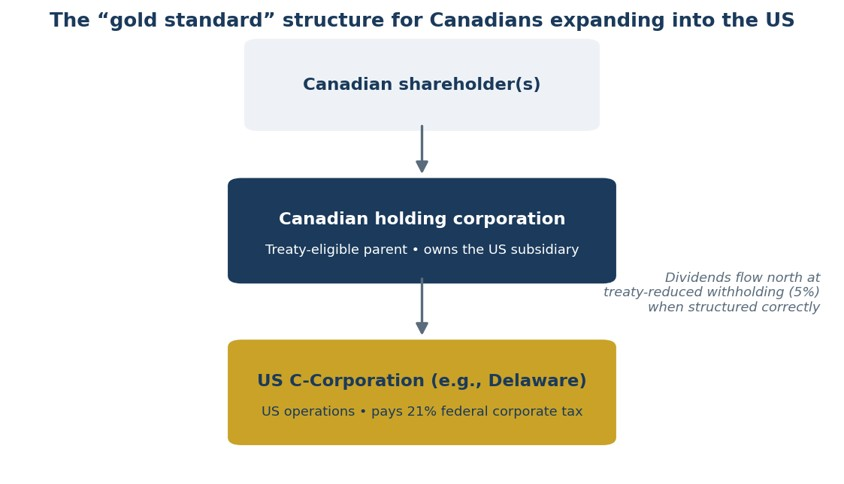
A few quick notes on the other entities you’ll hear about. S-Corporations are simply off the table — only US citizens and residents can be shareholders, so any online advice pointing a Canadian toward an S-Corp is wrong on arrival. Limited partnerships are useful in real estate and investment structures but can inadvertently create a permanent establishment; use them only with proper planning. ULCs (unlimited liability companies) are advanced tools used mainly by US companies investing into Canada — not DIY structures.
Delaware or Wyoming? Credibility usually beats cost
Delaware’s advantage isn’t tax — a Delaware company still pays 21% federal tax, and any state where you actually operate can tax you regardless of where you incorporated. Delaware’s advantage is legal predictability and credibility: a specialized business court, decades of case law, and instant recognition from banks, investors and acquirers. Wyoming is cheaper and lighter on compliance, which can suit a very small, US-only operation — but for Canadians, its “no state tax” pitch is largely irrelevant (Canada taxes your worldwide income anyway), and unfamiliar structures can slow down banking and financing. Choosing Wyoming to save a few hundred dollars a year can cost real money later. Incorporation location never overrides tax residency, treaty rules, or economic substance — a Delaware entity managed entirely from Canada still raises permanent establishment and transfer pricing questions.
One page that prevents audits: the organizational chart
Tax authorities, banks, and investors all start with the same question: who owns what, and where does the money flow? An organizational chart answers it in seconds, supports treaty claims and transfer pricing positions, and lowers audit friction. My rule of thumb after more than 10 years in practice: if your structure can’t be explained on one page, it needs to be simplified — not explained better.
FAQ
What is the safest US structure for a Canadian?
In most cases, a US C-Corporation owned by a Canadian corporation. It aligns both countries’ tax treatment and integrates cleanly with the treaty.
Can a Canadian legally own a US LLC?
Yes — legality isn’t the issue. The problem is tax treatment: the mismatch between US and Canadian classification frequently produces double taxation.
Is Delaware required to do business in the US?
No. You can incorporate in any state, and you’ll register wherever you actually operate. Delaware is simply the most widely accepted legal domicile for companies that expect to grow or raise capital.
I already have an LLC. Is it too late?
No — but don’t wait. Depending on the facts, elections, reorganizations, or migration to a C-Corp can contain the damage. The longer profits accumulate in the LLC, the more expensive the fix.
Can poor structuring really cause double taxation?
Absolutely — and it happens far more often than people realize. It is much cheaper to structure correctly at the start than to unwind a problem after growth.
JMT Taxation Services Inc advises Canadian and US businesses and individuals on both sides of the border. If any of the situations above sound familiar, contact us before a small question becomes an expensive problem.

Highly ambitious and creative individual with an affinity for developing tax efficient results. Providing an emphasis on consultation and tax planning for client growth relationships.
View All Articles