Skip to content

US Corporate Income Tax for Canadians: What Triggers It, and How the Treaty Protects You

6 min read

Here is a conversation I have with Canadian business owners more often than I’d like: a company has been selling into the US for three years, sales are growing nicely — and then a letter from the IRS arrives, or a US customer’s procurement department asks for a W-8BEN-E, and suddenly nobody is sure whether a US tax return should have been filed all along. The uncomfortable truth is that US tax obligations are triggered by what your business does, not by where it is incorporated. You do not need a US company, a US office, or even a US bank account to have a US filing requirement.

The good news: US corporate tax is entirely manageable when you understand three concepts — Effectively Connected Income, Permanent Establishment, and the Canada–US tax treaty. This guide walks through all three, plus the pitfalls I see most often in practice.

The basics: a flat 21% federal rate — plus state and local layers

The US applies a flat federal corporate income tax rate of 21%. There are no graduated brackets: the first dollar of profit and the millionth are taxed at the same rate. But the federal tax is only one layer. Most states impose their own corporate or franchise taxes, generally ranging from about 2% to 12%, and some cities add a third layer. Each level has its own filing requirements — and, critically, a company can owe state tax even when the treaty shields it from federal tax, because most states are not bound by the treaty.

Effectively Connected Income: the concept that catches people

Effectively Connected Income (ECI) is income linked to carrying on a trade or business in the United States. Common triggers include revenue earned through a US office or branch, services physically performed in the US, and sales generated by US-based employees or dependent agents. If income is ECI, it is taxed in the US on a net basis — much like a US corporation’s income.

Pro tip from practice: many Canadian companies create ECI without realizing it — simply by hiring one US-based salesperson or letting a US contractor sign deals on their behalf. Remote sales don’t automatically protect you; the facts of your activity matter more than your intentions.

How the Canada–US treaty protects business profits

Under the Canada–US Income Tax Convention, a Canadian company’s business profits are exempt from US federal tax unless it has a Permanent Establishment (PE) in the US. A PE typically exists when you have a fixed place of business (office, warehouse, factory) or people in the US with authority to habitually conclude contracts in your name.

Treaty protection, however, is not automatic — it must be claimed. In practice that means filing a US corporate return (Form 1120-F) with Form 8833, Treaty-Based Return Position Disclosure. Think of it from the IRS’s perspective: a return showing US$1 million of revenue and zero tax raises a red flag — unless the treaty position is properly disclosed. Skipping the protective filing is one of the most expensive shortcuts in cross-border tax: it can forfeit deductions and expose the company to penalties.

The branch profits tax: the surprise second layer

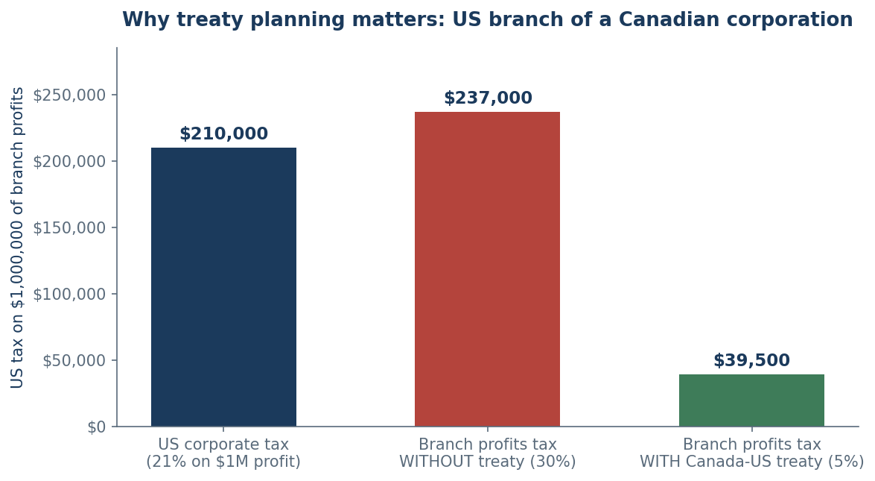
If a Canadian corporation operates in the US through a branch (rather than a US subsidiary), a second federal tax applies on top of the 21% corporate tax: the branch profits tax. It exists to mirror the dividend withholding tax a subsidiary’s profits would face when repatriated. The statutory rate is a punishing 30% of after-tax branch earnings — but the Canada–US treaty reduces it to 5% for qualifying Canadian corporations, and exempts the first CAD $500,000 of cumulative branch profits.

On $1M of branch profit: US corporate tax of $210,000, then branch profits tax of $237,000 (30%) without treaty relief — versus $39,500 (5%) with it. Claiming the treaty properly is worth roughly $200,000 here.

Losses: know the rules before you need them

Corporate capital losses offset capital gains only — never operating income — and net capital losses carry back 3 years and forward 5. Net operating losses (NOLs) arising after 2017 carry forward indefinitely but generally cannot be carried back, and can offset only 80% of taxable income in a given year. Ownership changes can restrict NOL use, so track losses carefully by category and vintage.

FAQ

Yes — if they earn effectively connected income, or need a filing to claim treaty protection. In many cases the protective filing is required even when no tax is owed.

No. It depends on whether your activities create ECI or a Permanent Establishment. Pure exports with no US people or premises usually don’t — but one US employee can change the analysis.

A flat 21% at the federal level, plus state corporate taxes of roughly 2%–12% depending on where you have nexus.

Yes. Most states apply their own nexus and apportionment rules and are not bound by the Canada–US treaty. This is one of the most overlooked risks for Canadian companies entering the US market.

Waiting too long. US exposure usually builds quietly during growth, and the cost of fixing missed filings — some international penalties start at US$10,000 per form, per year — far exceeds the cost of planning early.

JMT Taxation Services Inc advises Canadian and US businesses and individuals on both sides of the border. If any of the situations above sound familiar, contact us before a small question becomes an expensive problem.

Jeremy Tordjman

Highly ambitious and creative individual with an affinity for developing tax efficient results. Providing an emphasis on consultation and tax planning for client growth relationships.

View All Articles